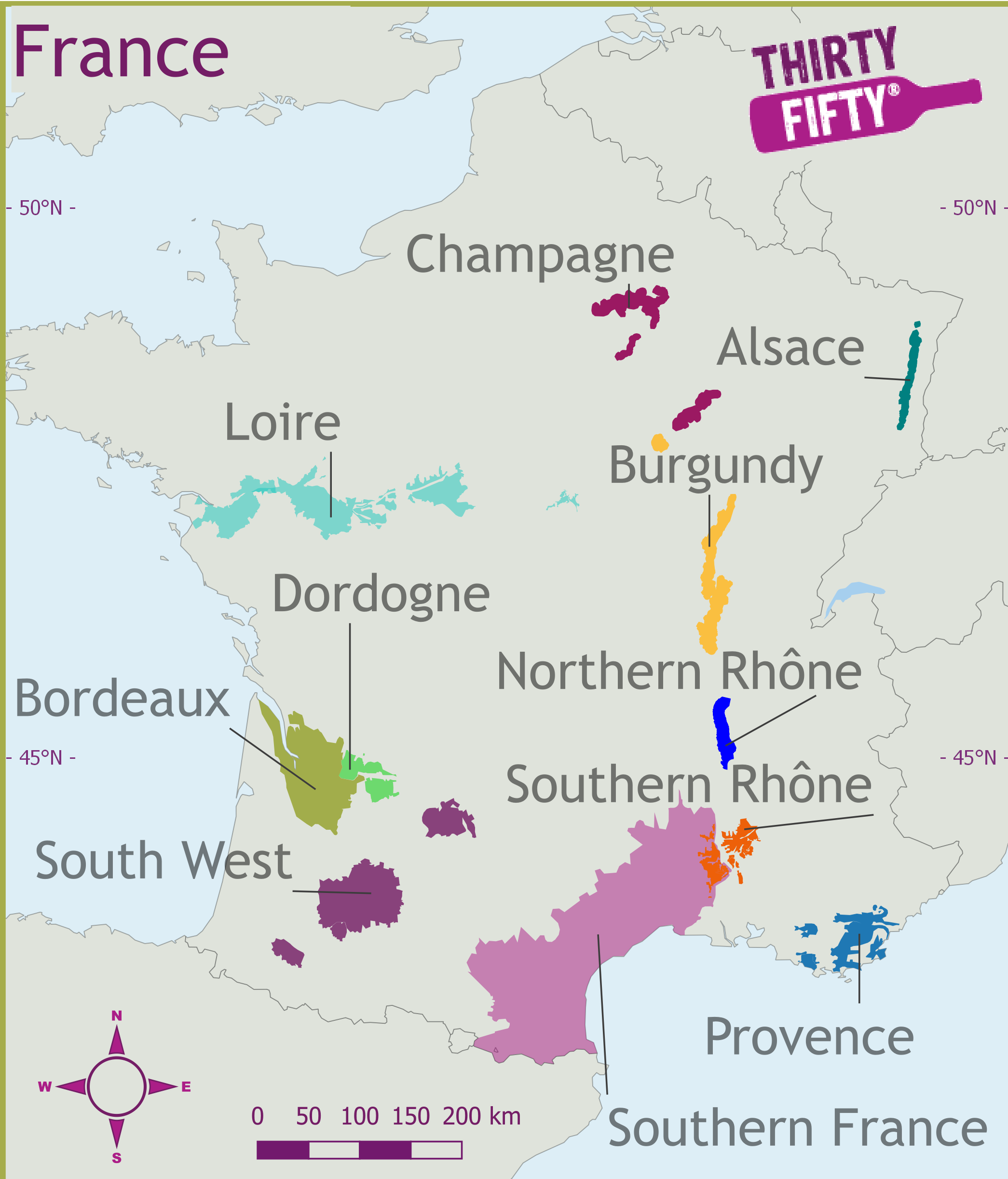


The Right Bank's Grapes: Cabernet Franc, Cabernet Sauvignon, Merlot
Cabernet Franc
It would hard to talk about the French black grape variety Cabernet Franc without mentioning Cabernet Sauvignon, the variety with which it is frequently blended and to which it quite regularly plays second fiddle. But then they are related � Cabernet Franc is a parent of the more widely planted Cabernet Sauvignon, along with Sauvignon Blanc. Not surprisingly, then, does Cabernet Franc share many characteristics with its offspring, though the resulting wine is lighter and less tannic. Expect something light to medium bodied, with good aromas, including some herbaceousness reminiscent of unripe Cabernet Sauvignon but with more immediate fruit. Cabernet Franc is happy in cool, inland climates, such as the middle Loire (Anjou-Saumur and Touraine) and the Libournais in Bordeaux. It buds and matures over a week earlier than Cabernet Sauvignon, is easier to ripen fully and less troubled by poor weather during harvest. In Bordeaux�s Medoc and Graves, where it is always blended with other grapes, it is planted as insurance in case the Cabernet Sauvignon or Merlot harvests fall foul of the weather. As well as being found all over southwest France, it�s also prevalent in northwest Italy (though some of what was thought to be Cabernet Franc has turned out to be Carmenere), is gaining popularity in Tuscany and central Italy as a supplement to their Cabernet Sauvignon, and appears in Slovenia and further east. In most other countries where there are Cabernet Franc vineyards (the New World, for instance), it is there for one reason: to blend with Cabernet Sauvignon for a Bordeaux mix. Occasionally, it brings something surprising too � Canada, for example, has made ice wine from it and, of course, it would be remiss not to mention Bordeaux beauty Cheval Blanc � the most exalted Cabernet Franc-dominated wine in the world.
Cabernet Sauvignon
Cabernet Sauvignon is perhaps the most famous red grape. Its home is Bordeaux where it is was created as a cross between Cabernet Franc (red grape) and Sauvignon Blanc (white grape). Since then its popularity has spread and it is grown all around the world. It prefers warmer climates to ripen fully and even in Bordeaux some years it does not ripen. That is why Cabernet Franc is also used in Bordeaux blends as it ripens faster. What makes Cabernet so popular is not its bouquet, which can range from blackcurrants to cigar box, but its structure, typically having both tannins and acidity to create a smooth feeling in the mouth. The structure allows the blending with other grapes, perhaps the most famous pairing is Cabernet Sauvignon and Merlot where the Cabernet provides the structure and the Merlot gives the wine the soft, rounded feel in the mouth. Recently Cabernet has been mixed with Sangiovese (Chianti's grape) to create the SuperTuscans.
Merlot
Merlot makes luscious, smooth and fruity wines. In spite of this, it�s still perceived as one of the vine world�s great underdogs, most often being unfavourably compared to prized Cabernet Sauvignon, its more austere and frequent blending partner. Planted throughout South West France and much of the rest of the world, Merlot means �little blackbird� in Bordeaux patois, and was so-called because it was said that it�s the grape the blackbird guzzles first and that the bird�s colour resembles the grapes. It produces its most glorious wines in St-Emilion and Pomerol, on the right bank of the Gironde, including Bordeaux�s most expensive wine, Chateau Petrus. Chile's soft plum aromas are a favourite to many consumers. Merlot can adapt to a wide range of soils and microclimates, but it buds, flowers and ripens relatively early, so spring frosts are a danger. Its thin-skinned grapes are also liable to rot in wet vintages. However, Merlot�s lowish fruit tannins make it an excellent early-drinking wine.
PDO's & PGI's
- AOC Pomerol
- AOC Saint-Emilion
The Right Bank
Key Grape Varieties: Cabernet Franc, Cabernet Sauvignon, Merlot