Moët Hennessy launches Provence rosé in a flat plastic bottle
The bottle is made from plastic recovered from coastal areas, helping to reduce plastic waste. Read more »


To book a wine tasting call us on
020 8288 0314 or to get in touch by
email please
click here.

Sign up to our Wine Club newsletter and keep up to date
with your wine knowledge, our latest on courses and
events.
BOOKINGS: 020 8288 0314


Mourvedre is a vigorous red grape variety high in acidity and often astringency that is enjoying a revival in the south of France. It most likely originated in Spain, where – although declining – it is the fourth most planted red wine grape and known as Monastrell. With a warm climate, Mourvedre adapts well to a good range of soils and will ride out spring frosts. However, it doesn’t like low winter temperatures and is susceptible to downy and powdery mildew, which are more common in much of France than Spain. It buds and ripens very late – not a problem in Spain but in France it needs the warmest of summers to reach full ripeness. As Monastrell, the grape is grown particularly in Murcia, Alicante, Albacete, Valencia and the Levante where the resulting wines tend to be high in tannin and alcohol with a gamey flavour in youth – but it can age too. In southern France – throughout the Languedoc and Roussillon, as well as in Provence and the southern Rhone – Mourvedre is often used for its structure and makes wine with intense fruit and the aroma of blackberries in a good year. The Australians and Californians often called this grape Mataro but now, as a varietal or in a blend, it’s being offered as Mourvedre.
PDO's & PGI's
Key Grape Variety: Mourvedre
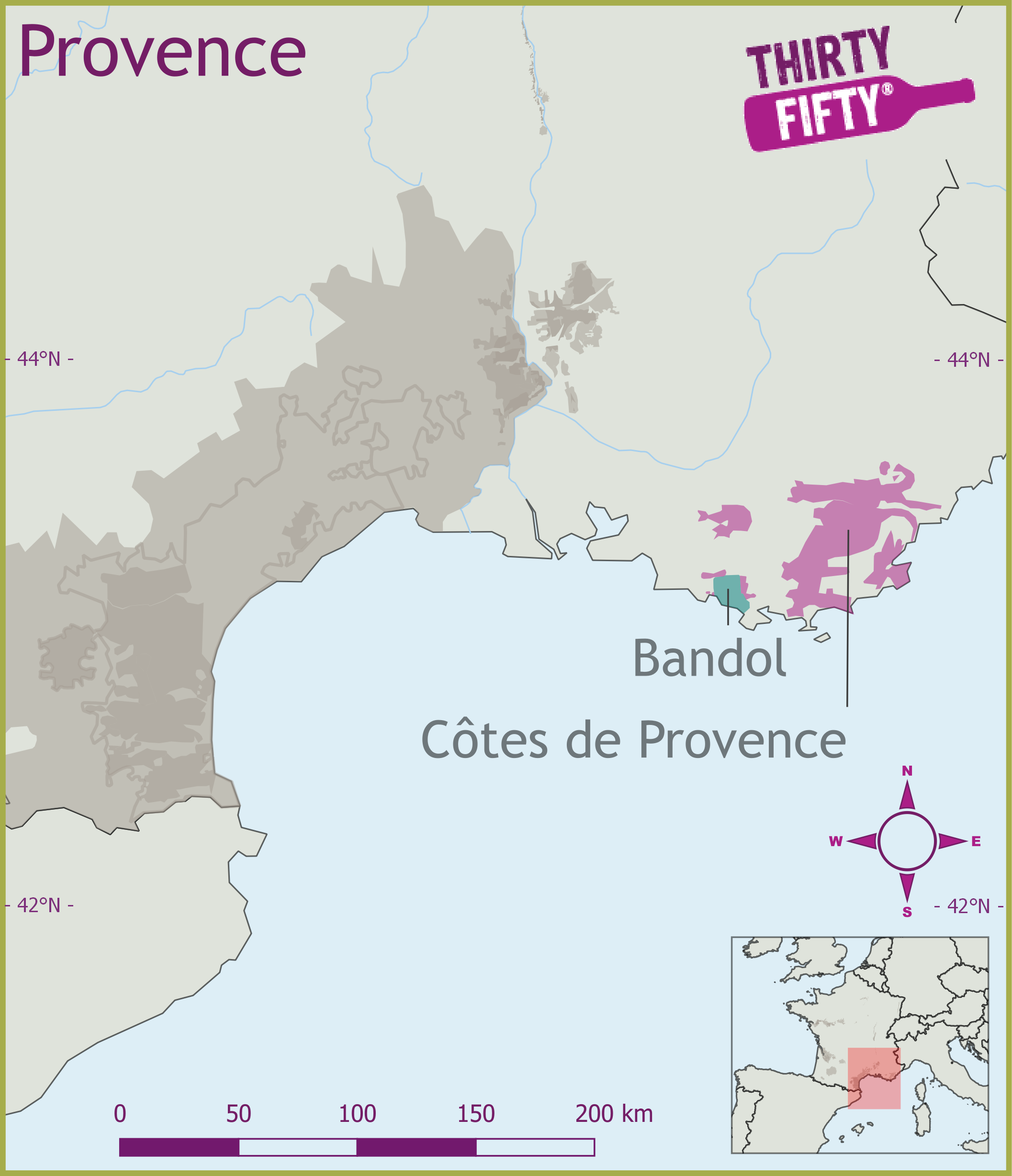
Provence is France’s most Mediterranean wine region, boasting an average of 3,000 hours of sun a year and less than 700 mm of rainfall annually. Here, in the far southeast of the country, Grenache is the most planted grape, followed by Carignan, Syrah and Cinsaut. However, the region produces a wide range of varieties as a result of its historical influences. Look at the Cotes de Provence appellation, the most significant in the region - it permits up to 13 different grapes, from Grenache, Carignan and Cinsaut to Ugni Blanc, Clairette, Mourvedre, Tibouren, Calitor, Barbaroux, Rolle and Semillon.
The majority of wine produced in Cotes de Provence is pale pink dry rosé. A lot of this is just quaffing wine but some is serious stuff, with more flavour and even some oak. Whichever, this is wine designed to be drunk well-chilled and young and is a perfect match for the food of the region.
Red is the new rosé though for serious wine producers here, who have been replacing the long-grown Carignan with Syrah and Cabernet Sauvignon to give structure to the more subtle permitted varieties. That’s not to say that whites are forgotten though – increasing numbers of producers are putting in effort here too, especially around the coastal areas.
Provence’s other appellations include: Coteaux d’Aix-en-Provence - making mainly dry rosé and reds, often from vineyards located among Provence’s beautiful lavender and garrigue; Bandol - producing Provence’s most serious wine, typically, deep-flavoured reds dominated by Mourvedre; Bellet – producer of red, white and rosés but the scented, full-bodied whites made from Rolle with Chardonnay and sometimes Bourboulenc are the ones worth mentioning; Cassis - mainly whites; Palette and Coteaux Varois. Finally, there is Les Baux de Provence, which is the first appellation in France to demand that all wines are produced biodynamically;
Provence’s climate makes it particularly suitable for organic viticulture. The Mistral assists this as it minimises the risk of fungal diseases, though vineyards need careful siting to be protected from this wind.

We focus in on the Provence region and the climate with Jerome Pernot and the vineyards of Chateau Leoube.

Jerome Pernot at Chateau Leoube takes us into the vineyard to look at the vines and gives us an overview of their wines.

We talk about how rose wine is made with Jerome Pernot from Chateau Leoube, Provence.
The bottle is made from plastic recovered from coastal areas, helping to reduce plastic waste. Read more »