





Touraine's Grapes: Cabernet Franc, Chenin Blanc, Sauvignon Blanc
Cabernet Franc
It would hard to talk about the French black grape variety Cabernet Franc without mentioning Cabernet Sauvignon, the variety with which it is frequently blended and to which it quite regularly plays second fiddle. But then they are related � Cabernet Franc is a parent of the more widely planted Cabernet Sauvignon, along with Sauvignon Blanc. Not surprisingly, then, does Cabernet Franc share many characteristics with its offspring, though the resulting wine is lighter and less tannic. Expect something light to medium bodied, with good aromas, including some herbaceousness reminiscent of unripe Cabernet Sauvignon but with more immediate fruit. Cabernet Franc is happy in cool, inland climates, such as the middle Loire (Anjou-Saumur and Touraine) and the Libournais in Bordeaux. It buds and matures over a week earlier than Cabernet Sauvignon, is easier to ripen fully and less troubled by poor weather during harvest. In Bordeaux�s Medoc and Graves, where it is always blended with other grapes, it is planted as insurance in case the Cabernet Sauvignon or Merlot harvests fall foul of the weather. As well as being found all over southwest France, it�s also prevalent in northwest Italy (though some of what was thought to be Cabernet Franc has turned out to be Carmenere), is gaining popularity in Tuscany and central Italy as a supplement to their Cabernet Sauvignon, and appears in Slovenia and further east. In most other countries where there are Cabernet Franc vineyards (the New World, for instance), it is there for one reason: to blend with Cabernet Sauvignon for a Bordeaux mix. Occasionally, it brings something surprising too � Canada, for example, has made ice wine from it and, of course, it would be remiss not to mention Bordeaux beauty Cheval Blanc � the most exalted Cabernet Franc-dominated wine in the world.
Chenin Blanc
Chenin Blanc is a native of France, or more specifically the Loire, yet it's now more prevalent in South Africa, where it is the most planted grape. This white grape is certainly versatile: it goes from producing some of the finest, most age worthy sweet wines to being responsible for a vast amount of sparkling wine, basic New World gluggers and high-quality examples. In South Africa, it is also used as a base for fortified wines and spirits. The variety is marked by the flavours of honey, flowers and damp straw as well as high acidity, which can be a problem in the Loire's less-ripe vintages but is a bonus in hotter climates. It's a vigorous grower with good resistance to disease and wind, but it buds early, which exposes it to spring frosts, and ripens late. In newer wine regions, it's grown on a wide variety of soils but French growers prize the calcareous soils, particularly the tuffeau of Touraine. In fact, it's Touraine as well as Anjou-Saumur that are Chenin's bases today in the Loire. Here, wines range from basic and vaguely floral to intense honeyed wines made either sweet (moelleux), dry or demi-sec, but all with vibrant acidity. The region's Chenin sparklers include Saumur Mousseux, Cremant de Loire and Vouvray, while, in the south, the grape is also an ingredient with Mauzac and Chardonnay in the sparkling wines of Limoux. Chenin Blanc is also grown in other New World countries, including Australia and America (mostly California), where it's often blended. In France, it is sometimes called Pineau or Pineau de la Loire and in South Africa it also goes by the name Steen.
Sauvignon Blanc
Grassy and herbaceous, with the characteristics of gooseberries, nettles and cat�s pee � this can only be referring to one grape variety: Sauvignon Blanc. The grape has its origins in Bordeaux but is now widely cultivated over France and around much of the world. Think of Pouilly-Fume and Sancerre from the Loire � both these wines are made from Sauvignon Blanc and are, probably, the grape in its purest form: crisp, dry, aromatic and unoaked. In Bordeaux, it�s blended, particularly with Semillon, for the dry whites there, but it�s also an ingredient for the region�s luscious dessert wines, such as those of Sauternes and Barsac. On the other side of the world, however, New Zealand has also virtually made this white variety its own, giving the wine a screwcap along the way. Yet this fashionable grape does have its faults. For one, unblended, it doesn�t age. Wines made from Sauvignon Blanc are generally meant to be drunk young, but then that can also be a bonus � as soon as you�ve bought a bottle, you can just chill this zesty little number and enjoy it! On the growing front, it�s susceptible to botrytis, oidium and black rot and will also rot if grown on fertile soils, preferring gravelly or sandy loams, or chalk in parts of the Loire. It also tends to be very vigorous and if it�s allowed to become over-productive on heavy soils, then the characteristics of the wines will be much diluted. Sauvignon Blanc goes by a few other names, the most common probably being Fume Blanc, as it�s known in California.
PDO's & PGI's
- AOC Bourgueil
- AOC Chinon
- AOC Touraine
- AOC Vouvray
Touraine
Key Grape Varieties: Cabernet Franc, Chenin Blanc, Sauvignon Blanc
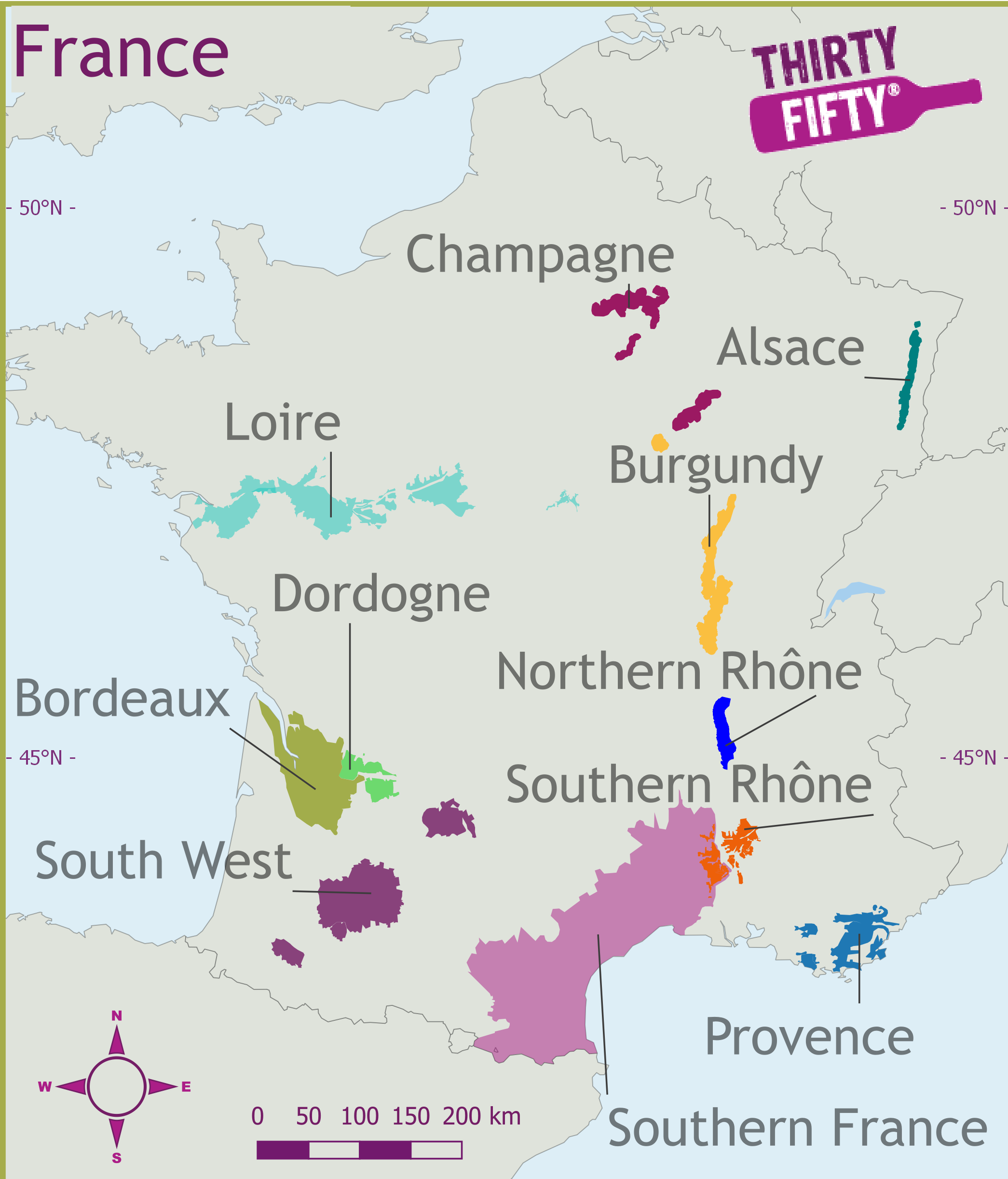
Touraine is an AOC (Appellation d'Origine Controlee) in the very heart of the Loire Valley in France. It's AOC status was awarded in 1939. Touraine has its own generic regional appellation called Touraine which covers the entire district as well several titles that are more specific in terms of both location and wine style. These range from the dry fruity reds of Saint-Nicolas de Bourgeueil to the diverse whites of Vouvray and Moutlouis.
The Touraine district is located a full 140 miles from the Atlantic Ocean and the same distance from the northern Massif Central hills of central France. So the climate falls between maritime and continental. There is a noticeable difference between the cold drier winters in the districts eastern edges and those in the west which tend to be slightly wetter and more temperate. In summer the slow moving waters of the Loire do little to cool the Touraine vineyards as this region is known for its hot torpid summer days.
Touraine produces wines in every colour, white, rose and red from an extensive palette of grape varieties. The whites are typically dry and the red wines rich in tannins. The soil in Touraine is highly varied with flinty clays, clay limestone on a chalk bed and sand on flint to the east as well as gravel stones and sand. Throughout the Touraine the better vineyard sites are blessed with free-draining soils rich in tuffeau. Tuffeau is the calcareous rock which this part of the Loire is famous. It has 2 key forms the chalkier firmer tuffeau blanc and the softer sandier tuffeau jaune. Tuffeau jaune underpins the Loire's finest Cabernet Franc vineyards in Saumur in the west of the region.
The climatic differences combined with varied soils determine the choice of grape variety planted (with later ripening varieties in the west and earlier ripening ones in the east) and therefore a wide variety of wines are produced. Annual production figures for this region are as follows:- White 105,000 hl, Red 88,000 hl, Rose 19,000 hl and sparkling 27,000 hl. The main still red grape varieties are Gamay, Cabernet Franc and Malbec (known locally as Cot) with smaller proportions of Cabernet Sauvignon and Pinot Noir. The white grapes which make up roughly half of all Touraine wines are dominated by Sauvignon a combination of Sauvignon Blanc and less commonly Sauvignon Gris. Other whites include Chenin Blanc and Arbois grapes. Touraine Roses which make up less than 10% of the regional production are created using the same varietal’s as the reds with the addition of the Loire’s less favoured Grolleau Noir and PIneau D'Aunis and even Pinot Meunier.
Separate appellations in this sub region are: - Touraine, covers the entire sub-region. “Touraine Primer” is made exclusively from the Gamay Noir a Jus blanc grape variety. Touraine-Amboise , covers 10 communes Red wines produced here are from Cabernet Franc (known locally as Breton) Cabernet Sauvignon, Cot and Gamay Noir with the the white wines are made from Chenin Blanc known locally as Pineau de la Loire. Touraine Melsnad, gives its name to red, rose and white wines of considerable finesses produced from Gamay and Chenin grapes. Touraine Azay-le-Rideau produces whites from Chenin and to Rose made from Chenin, Gamay and Grolleau grapes. Bourgueil is one of the largest regions of the Touraine this is mainly Cabernet Franc country. Depending on the soil 2 different types of wine are produced. Wines from fine gravel soils must be drunk when very young, while wines from calcareous tuffeau soils develop their flavours and aromas a year later. Saint-Nicolas-de-Bourgueil close to the Bourgeueil wine growing area in terms of distance but the wines produced here are of exceptional quality. These wines have very strong red fruit flavours and can be kept very successfully for more than 10 years. Chinon - these wines are often better known than the Saint-Nicolas-de-Bourgueil wines and are less fruity. These wines are linked to Rabelais a famous French Renaissance writer. Vouvray situated on the right bank of the Loire has an international reputation and only produces white wines. Some Vouvray is semi-sparkling or sparkling. If kept in good conditions Vouvray wines can be kept for 40 years. Montlouis east of Tours shares its name with white wines that are less well known outside of the Touraine region and are all made from Chenin grapes. Some Montlouis wines are semi-sparkling or sparkling.

