New Pouilly Premier Crus
Pouilly-Loché and Pouilly-Vinzelles achieve Premier Cru status after 18 year process by the INAO. Read more »


To book a wine tasting call us on
020 8288 0314 or to get in touch by
email please
click here.

Sign up to our Wine Club newsletter and keep up to date
with your wine knowledge, our latest on courses and
events.
BOOKINGS: 020 8288 0314


Jancis Robinson described Chardonnay as the tart of the grape world, as it would lie down anywhere and do what the winemaker told it to do! In other words it will grow almost anywhere and produce decent and quite stylistically different wines ranging from minerally Chablis, Champagne, buttery fruit wines, tropical fruit wines or oaky vanilla wines. During the late 1990's Chardonnay was the drink of choice for many. However people became bored with the oaky wines found in so many bars and the term, 'ABC' (Anything but Chardonnay) came about. The ubiquitous yet noble Chardonnay grape has virtually become a brand name. From its homeland in Burgundy, its fame and fortune have taken it all over the world. It�s grown on different soils in varying climates to be used either as a single varietal or in blends, for still and sparkling wines, and with or without oak ageing to create a wide range of wines with diverse personalities. As a result, it�s impossible to describe a typical Chardonnay. For a start, the grape can make anything from an everyday glugger to a high-quality wine deserved of ageing. Its popularity in the vineyard stems from the fact that it�s easy to grow, consistently yielding generously with relatively high sugars (and, therefore, alcohol). In the winery its advantages are obvious � it�s difficult to make a poor wine from it, unless it�s been picked too late, because then its acid levels fall quickly, which make it flabby. Chardonnay isn�t strongly aromatic: some detect anything from apples (or barely ripe apples in Chablis) and melon in Maconnais Chardonnay to tropical fruit flavours in New World examples. Common descriptives, however, tend to refer to texture and weight rather than flavour � buttery for broader styles, such as Meursault from the Cote de Beaune; steely for Montrachets and nutty for Corton-Charlemagne. There�s an attractive leanness to fine Cote d�Or white burgundy, that sets it apart from Chardonnays from the rest of the world, but this can be emulated further south in the Cote Chalonnaise and Maconnais in good vintages with clever winemaking.
Pinot Noir (pronounced PEA-no NWAHR, the grape that produces Burgundy's finest red wines, is one of the hardest to grow. This thin-skinned variety is generally an early budder and ripener, so it is best-suited to cool, marginal climates - 40 to 50 degrees latitude - and only produces good wine when the fruit is controlled to very low yields. It has the problem that it mutates easily and is also particularly susceptible to leaf roll, and to rot because of its compact grape bunches. Pinot has no single recognisable flavour or style. Young Burgundy, however, can be reminiscent of raspberries or strawberries, while mature French Pinot tends to evolve into anything from violets, game and truffle to farmyard aromas and compost. Despite its difficult temperament, Pinot Noir is hardly just a French phenomenon. It crops up in Northern Italy, Germany, Switzerland and Eastern Europe as well as California, Australia, New Zealand and even South Africa and Chile. It�s a successful ingredient for sparkling wine and is one of three grapes used in champagne, bringing good acidity, structure and body. Pinot Noir goes by a long list of names, which include Spatburgunder and Blauburgunder in Germany and Klevner in Switzerland.
Gamay is the grape responsible for Beaujolais and, although it does pop up in a few other places, it is probably more than any other internationally known grape variety associated with this single wine region and single wine type. Officially called Gamay Noir a Jus Banc, it is a early budder, flowerer and ripener, making it prone to spring frosts, but it is able to flourish in regions as cool as much of the Loire, as well as other French regions � Maconnais and Savoie. Outside Beaujolais, this grape is chiefly valued in Switzerland. Gamay may well have originated further north than its main home � in the Cote d�Or, where it was planted extensively in the 14th century. However, now it has given way to Chardonnay bar a minor amount. Gamay wines, most of which are for drinking young, tend to be light purple with relatively high acidity, low tannin and the aroma of freshly picked red fruits often layered with bananas, boiled sweets and acetone, which are the smells that result from rapid, anaerated fermentation. Gamay excels on the rolling hillsides of the Haut-Beaujolais on granite-based soil. It is here that the finest wines are produced from the 10 Beaujolais crus, such as Fleurie and Morgon.
Wine Regions for Burgundy
PDO's & PGI's
Pronounced as: BURR-gun-dee
Key Grape Varieties: Chardonnay, Pinot Noir, Gamay
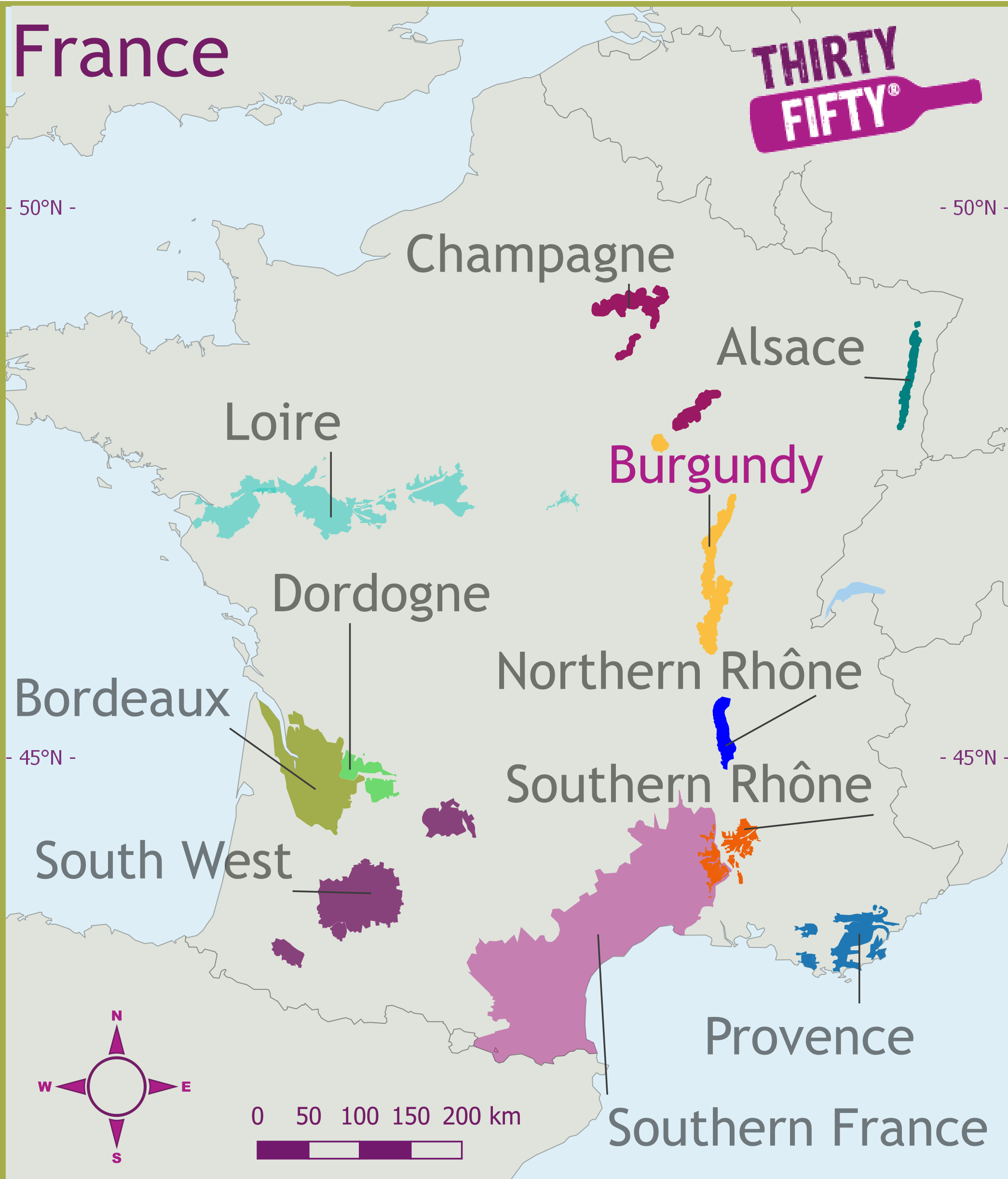
Burgundy (pronounced BURR-gun-dee) is the region where Pinot Noir and Chardonnay rule in France. In the northeast – and at the limit of successful ripening - this region calls its wine estates domaines rather than chateaux.
The area divides into sub regions: the Cote d’Or and, going south, the Cote Chalonnaise and Maconnais. The Cote d’Or is further divided into the northern Cote de Nuits, from which come the great reds of the region, produced on the escarpment, and the Cote de Beaune, which produces Burgundy’s most esteemed whites. In fact, Chardonnay here makes what is widely considered to be the finest, full-bodied dry white wines in the world. And, of course, who can forget Chablis? This appellation, producing steely, dry white wines in Burgundy’s most northerly vineyards, is now virtually a generic.
Burgundy’s climate is broadly continental, with dry winters and a more variable and shorter summer than Bordeaux. The region has a tendency to heavy rainfall in May and June, and again in October, which is sometimes a problem at harvest time. Spring frost is also an issue and hail causes damage most years. The soils are based on limestone, perhaps one reason why all the region’s best wines are made from Pinot Noir and Chardonnay.
Vineyards here are very small and usually split up between many winegrowers. Each grower cultivate his vines and makes his wine differently and much is sold in barrels and bottled by local shippers, so varying qualities appear on the market with the same wine name on the label. For this reason, the name of the winemaker and bottler are more important in Burgundy than in any other wine-producing area. Historically, Burgundy’s vineyards were classified into three classes. These were later incorporated into the appellation controllee system, so today Grand Crus are in theory the finest wines, followed by Premier Crus. Then come village wines and, finally, regional wine, such as simple Bourgogne rouge.
Domaine de la Romanee-Conti is the region’s most prestigious wine estate and the exception to the law stating that no Burgundian estate may be named after a specific vineyard.

Richard Brazier of Ancient and Modern Wines tells more about his business specialising in selling old wines in this second interview.

We talk with Christophe Coquard about Beaujolais Nouveau, the region, grape varieties and some of the unique methods in making Beaujolais Nouveau.

Domaine Jean Tardy is located in Vosne-Romanee in the Cote-d'Or, Burgundy. In part two of our interview with Guillaume Tardy we hear about the 2011 vintage.

Domaine Jean Tardy is located in Vosne-Romanee in the Cote-d'Or, Burgundy. In this third and final interview we speak to son Guillaume on his experience of Australian winemaking.

Domaine Jean Tardy is located in Vosne-Romanee in the Cote-d'Or, Burgundy. We speak to son Guillaume on how the business is shared between the family.

Crown Wine Cellars provides high quality wine storage in Hong Kong, we talk to Greg Deeb about the fine wine market in Hong Kong.

Domaine Olivier Gard is a family run estate based in Nuits Saint-Georges in Burgundy. We speak with Olivier about his vineyards and innovative winemaking techniques.

Olivier Normand is a Burgundy courtier who acts as the export department for many small growers. Olivier gives us an overview of the region and the appellation system.

Domaine Lucien Boillot is a wine estate in Burgundy producing wine in Gevrey-Chambertin, Pommard and Volnay. We find out about the different styles of Pinot Noir.

Maison Louis Latour is one of the most highly-respected negociants in Burgundy. We speak to Louis Latour about the activities of a negociant and their role in producing and selling Burgundy's wine.
Louis Latour of Burgundy negociant Maison Louis Latour gives us his thoughts on the concept of terroir and the impact of global warming in his part of France.

Nathalie and Gilles Fevre are the owners of Domaine Fevre in Chablis. We find out about the region and the wines of this famous French appellation.
Pouilly-Loché and Pouilly-Vinzelles achieve Premier Cru status after 18 year process by the INAO. Read more »
Burgundian Pouilly-Fuissé has had 22 vineyards approved for Premier Cru from the 2020 vintage. Read more »
Fine wine importer Flint Wines has completed the purchase of Burgundy specialist Domaine Direct. Read more »