Covid-19 news - marathons, restaurants and home deliveries
Medoc Marathon cancelled, restaurants struggles and home deliveries are all in this week's Covid-19 News round-up. Read more »


To book a wine tasting call us on
020 8288 0314 or to get in touch by
email please
click here.

Sign up to our Wine Club newsletter and keep up to date
with your wine knowledge, our latest on courses and
events.
BOOKINGS: 020 8288 0314


Cabernet Sauvignon is perhaps the most famous red grape. Its home is Bordeaux where it is was created as a cross between Cabernet Franc (red grape) and Sauvignon Blanc (white grape). Since then its popularity has spread and it is grown all around the world. It prefers warmer climates to ripen fully and even in Bordeaux some years it does not ripen. That is why Cabernet Franc is also used in Bordeaux blends as it ripens faster. What makes Cabernet so popular is not its bouquet, which can range from blackcurrants to cigar box, but its structure, typically having both tannins and acidity to create a smooth feeling in the mouth. The structure allows the blending with other grapes, perhaps the most famous pairing is Cabernet Sauvignon and Merlot where the Cabernet provides the structure and the Merlot gives the wine the soft, rounded feel in the mouth. Recently Cabernet has been mixed with Sangiovese (Chianti's grape) to create the SuperTuscans.
Merlot makes luscious, smooth and fruity wines. In spite of this, it�s still perceived as one of the vine world�s great underdogs, most often being unfavourably compared to prized Cabernet Sauvignon, its more austere and frequent blending partner. Planted throughout South West France and much of the rest of the world, Merlot means �little blackbird� in Bordeaux patois, and was so-called because it was said that it�s the grape the blackbird guzzles first and that the bird�s colour resembles the grapes. It produces its most glorious wines in St-Emilion and Pomerol, on the right bank of the Gironde, including Bordeaux�s most expensive wine, Chateau Petrus. Chile's soft plum aromas are a favourite to many consumers. Merlot can adapt to a wide range of soils and microclimates, but it buds, flowers and ripens relatively early, so spring frosts are a danger. Its thin-skinned grapes are also liable to rot in wet vintages. However, Merlot�s lowish fruit tannins make it an excellent early-drinking wine.
The qualitatively excellent Petit Verdot is one of Bordeaux�s classic varieties and has been established in the Medoc probably longer than Cabernet Sauvignon. However, it is no longer planted in any great quantity due to the fact that it ripens so late that in poorer years it doesn't ripen at all. Its other problem is that it is an irregular cropper, which makes it expensive to produce. Having said that, when everything works well, this thick-skinned black grape can produce concentrated, deeply coloured, spicy and tannic wines that are capable of ageing. Such desirable characteristics have found admirers among some of the quality-conscious chateaux and, as a result, it is enjoying a small revival. Traditionally, it has been planted more in the southern Medoc than the north where the soils and, therefore, the wines are lighter and some Petit Verdot in the blend adds deep colour and richness. In recent years other countries, such as Australia, California, Spain and Chile, have been experimenting with Petit Verdot and even using it as a dominant variety. Typically, it can give the flavours of violets, earth, leather, smoke and cigar box, along with the spice, mineral and peppery tones and the mouth-gripping tannins. In France it goes by a few other names � Petit Verdau, Verdot Rouge and Carmelin - and in Chile it�s called just Verdot.
PDO's & PGI's
Key Grape Varieties: Cabernet Sauvignon, Merlot, Petit Verdot
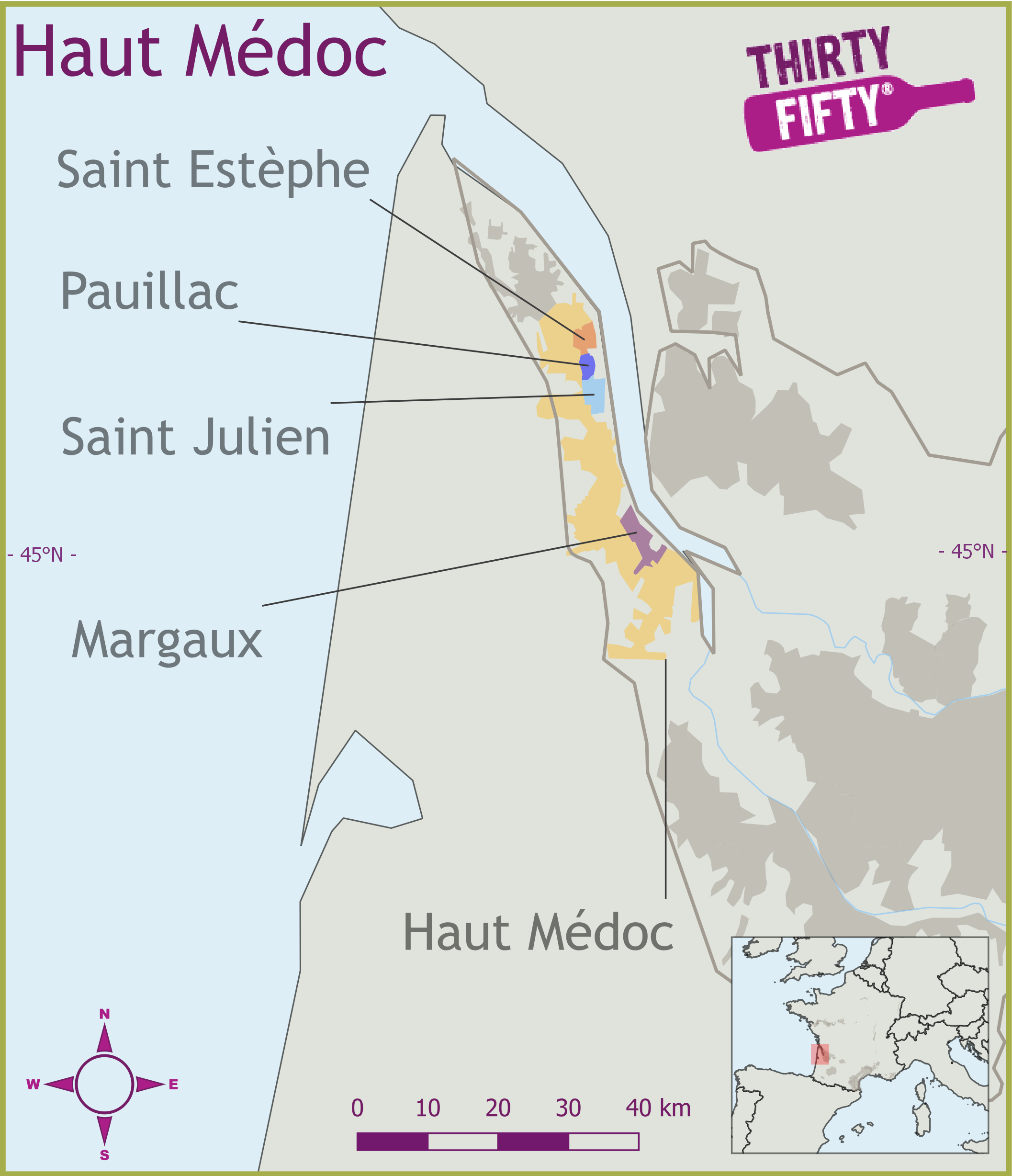
Red wine districts don’t get much more famous than Medoc in France. This area stretches northwest from the city of Bordeaux along the left bank of the Gironde estuary, but only wines from the northerly part of this vineyard strip, which is called the Bas-Medoc, use the Medoc appellation (those on the higher ground in the southern section come under the Haut-Medoc appellation – names like Margaux, Pauillac and St Estephe).
Medoc means ‘middle land’ in the local dialect and refers to the region being situated between the Atlantic ocean and the Gironde estuary, both of which help to moderate the climate. This is further assisted by the pine forests to the west, which protect the vineyards from strong winds off the Atlantic as well as moderate summer temperatures, so the Medoc enjoys the mildest climate in Bordeaux. However, it’s also the wettest, so rot is always a worry.
Merlot dominates on the 4,900 hectares of vineyards because the soils generally are clay-rich, heavy and moisture-retentive and this grape performs better on them, though on the higher ground there’s some gravel to lighten the clay. The resulting wines may have less finesse that those from the famed chateaux further south, but they are usually sound and solid, finding many fans.
Just as well as around 40 million bottles of red wine are produced here, the majority with Cru Bourgeois on the label, which in case you’ve not managed to keep up all the wine gossip, no longer means the same as it did a couple of years ago! Cru Bourgeois used to be a classification; now it’s a listing that properties have to apply for and be accepted for annually if they meet the right criteria and attain a level of quality. Gone are the Cru Bourgeois Exceptionnels and Superieurs that set chateaux apart within the system, but, sshh, there is now talk of cru bourgeois tiers maybe being brought in next year.