





Alsace's Climate: Cool Continental to Moderate Continental
Cool Continental
Temperature range ≤16.5 °C
Moderate Continental
Temperature range 16.5 - 18.5°C
Alsace's Grapes: Gewurztraminer, Muscat, Pinot Blanc, Pinot Gris, Riesling
Gewurztraminer
Gewurztraminer is a pink-skinned grape that produces headily scented and full-bodied white wines. It is cultivated in most parts of the globe, although most grown in Alsace in France, where it is designated a noble variety. Its origins are Italian – it was first noted in the village of Tramin, or Termeno, in what is now the Italian Tyrol, the region known as Alto Adige. Gewurztraminer is a mutation of the original Traminer grape and the one that is now the most planted variant. Gewurz means ‘spiced’ in German but in terms of the grape it really means ‘perfumed’. Lychees and rose petals are the characteristics with which it is most often associated, making it one of the easiest wines to distinguish by its nose alone. Wines from this variety are generally marked by high alcohol, often coupled with very low acids, which means cool climates do it a lot of favours. Hence, its success in countries such as Germany, Austria and, more recently, New Zealand. Its naturally high sugar level also makes it ideal for making sweet, late-harvest wines in sunnier years, the best of which can last for decades. Alsace produces just such examples labelled Vendange Tardive and Selection de Grain Nobles. Negatively, Gewurztraminer is a relatively low and erratic yielder (although the Germans have developed higher-yielding clones), is exceedingly prone to a variety of viruses and suffers from spring frosts because it leafs early. It ripens quite early too – and is always harvested before Riesling. But it’s a good-quality grape and one that is making a reputation for itself as a food wine, being that it goes particularly well with Thai and Chinese cooking. Its synonyms are as diverse as the styles of wine this grape produces, from Australia and America to Eastern and Western Europe.
Muscat
Pinot Blanc
French white grape variety Pinot Blanc is generally more of a workhorse grape than a star. It’s a member of the expansive family of vines that have been shown (according to DNA analysis) to be offspring of Pinot Noir and an obscure white grape planted in Burgundy in mediaeval times, Gouais Blanc Pinot Blanc has a roundness of flavour with occasionally an apparent sweetness as a result of its relative low acidity. The grape looks pretty similar to Chardonnay, so for many years no distinction was made between them, but Pinot Blanc is less full-bodied than its more common sibling and tends to be drunk young. However, with low yields, it is possible to barrel-age it with success. In France, this grape now tends to be most used in Alsace, where it is sometimes called Clevner or Klevner and often blended with Auxerrois, but, as Weissburgunder, it is held in more esteem in Germany, especially with growers looking for food-friendly wines. Here, it seems to show off the diversity of its personalities – it can be full and rich in Baden and the Pfalz, but relatively delicate along the Hahe and Mosel-Saar-Ruwer. Also as Weissburgunder, it excels in Austria, making almond-scented dry whites and also amazing, super-rich botrytized Trockenbeerenausleses. The ripest Weissburgunder tends to be oak-aged and is often blended with other grape varieties, particularly Chardonnay. In Italy, with the name Pinot Bianco, it’s widely grown – actually more so than in its homeland of France. It seems particularly happy grown in Collio and Isonzo in Friuli in the north of the country where it produces interesting, racy whites, both oaked and unoaked, with good body and flavour. Generally though, the Italians vinify Pinot Bianco as a slightly spritzy, high-acid wine for drinking young and for spumante in Lombardia. Elsewhere, Pinot Blanc is found all over eastern Europe, including in Slovenia, Croatia and Vojvodina, as Beli Pinot. The New World too has a little, with British Columbia in the west of Canada making some of the most noteworthy. Often though in Latin America what is called Pinot Bianco is actually Chenin Blanc. Likewise, in California, particularly in Monterey, older plantings of what was thought to have been Pinot Blanc turned out to be the Muscadel grape, Melon de Bourgogne. Carneros plantings, which are more recent, are true Pinot Blanc and these are used mostly for sparkling wine. It’s also grown in the Czech Republic, Slovakia and Hungary.
Pinot Gris
Pinot Gris is a mutation of Pinot Noir so, not surprisingly, it originated in Burgundy. With its �grey� grapes (well, any shade from greyish blue to brownish pink, actually), it�s found all around central Europe under a multitude of names � Rulander or Grauburgunder (when vinified dry) in Germany, the infamous Pinot Grigio in Italy, Szurkebarat in Hungary and Malvoisie in Switzerland as well as France�s Loire, Ain and Savoie, to name a few. It has also migrated to the cooler areas of the New World, such as New Zealand, parts of Australia and Oregon. Within France, however, Pinot Gris is most revered in Alsace, particularly because it partners food so well. Here, it�s also known as Tokay, a name over which there is some debate. It�s been suggested that a colonel in the imperial army brought vines back from Hungary to Alsace, having fought the Turks over the town of Tokay. Whatever it�s called, Pinot Gris produces soft, gently perfumed, full-bodied wines with relatively high extract and more colour than most whites. The grape�s characteristics are most pronounced in Alsace and Germany. While elsewhere � even within one country in the case of Australia - styles can vary from richer examples to more vibrant ones with lemon freshness and crisper acidity, rather like the Pinot Grigios of Italy. The vines have a good resistance to most pests and diseases, like deep soils with a high mineral content and can yield well with newer clones. Ripening depends again on location � for example, it�s earlier in Oregon, but late in Alsace � and this grape also has the ability to make deliciously sweet late-harvest wines.
Riesling
Riesling is probably the most misunderstood and mispronounced grape variety, despite being widely acknowledged by wine critics as one of the world's greatest grapes. Riesling is the noble grape variety of Germany, known there as the King of Grapes! Riesling ripens early and is best fermented cool. It should be bottled early with as little interference as possible in the processing - no oak-ageing or malolactic fermentation is required. As well as delicate dry to off-dry wines, Riesling produces some fine late harvest wines.
PDO's & PGI's
- AOC Alsace
- AOC Alsace Grand Cru
- AOC Crémant d'Alsace
Alsace
Pronounced as: al zass
Climate: Cool Continental to Moderate Continental
Key Grape Varieties: Gewurztraminer, Muscat, Pinot Blanc, Pinot Gris, Riesling
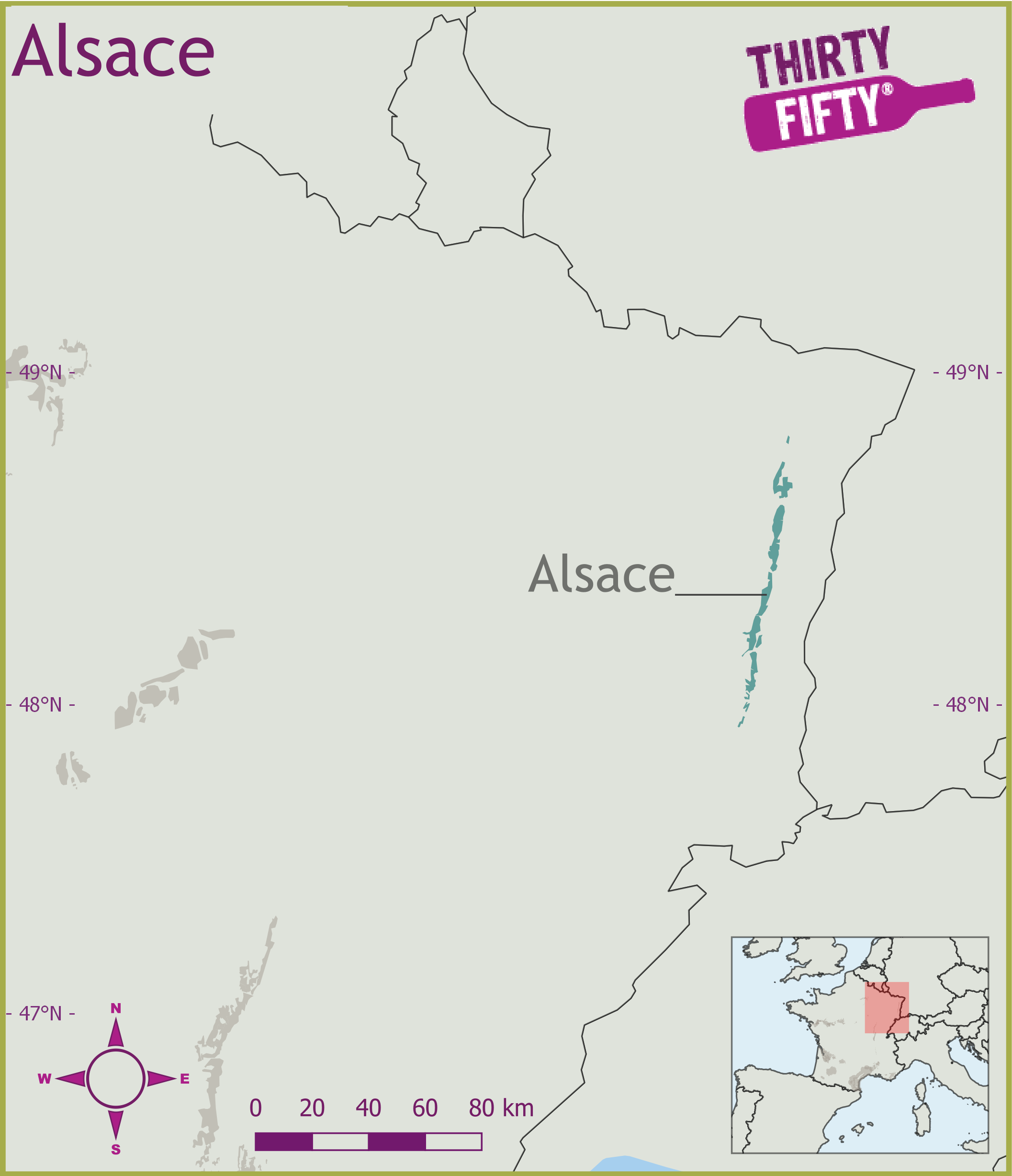
Alsace, on the eastern border of France, produces predominantly varietal white wine. It is a chocolate-box region of half-timbered houses and ruined castles and fortresses, which has at one time or another been German and French. Today, some 2,000 mostly family-owned growers bottle and sell their own wines, although over 80 per cent of them are produced by just 175 companies.
Alsace’s vineyards run through two departments: the Haut-Rhin and the Bas-Rhin, following the lower contours of the Vosges Mountains, which separate the region from the rest of France. Most of the best are on the south, southeast and southwest facing slopes in order to take advantage of maximum sunshine in this long, cool growing area; the more southerly Haut-Rhin tends to be regarded as producing better quality.
Soil types are diverse but generally the heavier clay and marl give more full-bodied and broader-flavoured wines; lighter limestone and sandy soils give more elegance and finesse; while flint, schist, shale and slate give the wines an oily, minerally, petrolly aroma, often described as gunflint. Particularly important in the region is the pink gres de Vosges subsoil. This is Vosges sandstone, which was used in the area to build churches and cathedrals.
Riesling, Gewurztraminer, Pinot Gris, Pinot Noir, Pinot Blanc, Muscat, Chasselas, Sylvaner and Auxxerois are the main grape varieties in Alsace and most growers plant all of them. Even the smallest growers make a wide range of wines each year – and, of course, bottle them in the traditional flute.


