Cabernet Franc has been reported to possibly come from Navarra
Cabernet Franc has been reported to possibly come from Navarra rather than France or the Basque Country Read more »


To book a wine tasting call us on
020 8288 0314 or to get in touch by
email please
click here.

Sign up to our Wine Club newsletter and keep up to date
with your wine knowledge, our latest on courses and
events.
BOOKINGS: 020 8288 0314


It would hard to talk about the French black grape variety Cabernet Franc without mentioning Cabernet Sauvignon, the variety with which it is frequently blended and to which it quite regularly plays second fiddle. But then they are related � Cabernet Franc is a parent of the more widely planted Cabernet Sauvignon, along with Sauvignon Blanc. Not surprisingly, then, does Cabernet Franc share many characteristics with its offspring, though the resulting wine is lighter and less tannic. Expect something light to medium bodied, with good aromas, including some herbaceousness reminiscent of unripe Cabernet Sauvignon but with more immediate fruit. Cabernet Franc is happy in cool, inland climates, such as the middle Loire (Anjou-Saumur and Touraine) and the Libournais in Bordeaux. It buds and matures over a week earlier than Cabernet Sauvignon, is easier to ripen fully and less troubled by poor weather during harvest. In Bordeaux�s Medoc and Graves, where it is always blended with other grapes, it is planted as insurance in case the Cabernet Sauvignon or Merlot harvests fall foul of the weather. As well as being found all over southwest France, it�s also prevalent in northwest Italy (though some of what was thought to be Cabernet Franc has turned out to be Carmenere), is gaining popularity in Tuscany and central Italy as a supplement to their Cabernet Sauvignon, and appears in Slovenia and further east. In most other countries where there are Cabernet Franc vineyards (the New World, for instance), it is there for one reason: to blend with Cabernet Sauvignon for a Bordeaux mix. Occasionally, it brings something surprising too � Canada, for example, has made ice wine from it and, of course, it would be remiss not to mention Bordeaux beauty Cheval Blanc � the most exalted Cabernet Franc-dominated wine in the world.
Cabernet Sauvignon is perhaps the most famous red grape. Its home is Bordeaux where it is was created as a cross between Cabernet Franc (red grape) and Sauvignon Blanc (white grape). Since then its popularity has spread and it is grown all around the world. It prefers warmer climates to ripen fully and even in Bordeaux some years it does not ripen. That is why Cabernet Franc is also used in Bordeaux blends as it ripens faster. What makes Cabernet so popular is not its bouquet, which can range from blackcurrants to cigar box, but its structure, typically having both tannins and acidity to create a smooth feeling in the mouth. The structure allows the blending with other grapes, perhaps the most famous pairing is Cabernet Sauvignon and Merlot where the Cabernet provides the structure and the Merlot gives the wine the soft, rounded feel in the mouth. Recently Cabernet has been mixed with Sangiovese (Chianti's grape) to create the SuperTuscans.
Chenin Blanc is a native of France, or more specifically the Loire, yet it's now more prevalent in South Africa, where it is the most planted grape. This white grape is certainly versatile: it goes from producing some of the finest, most age worthy sweet wines to being responsible for a vast amount of sparkling wine, basic New World gluggers and high-quality examples. In South Africa, it is also used as a base for fortified wines and spirits. The variety is marked by the flavours of honey, flowers and damp straw as well as high acidity, which can be a problem in the Loire's less-ripe vintages but is a bonus in hotter climates. It's a vigorous grower with good resistance to disease and wind, but it buds early, which exposes it to spring frosts, and ripens late. In newer wine regions, it's grown on a wide variety of soils but French growers prize the calcareous soils, particularly the tuffeau of Touraine. In fact, it's Touraine as well as Anjou-Saumur that are Chenin's bases today in the Loire. Here, wines range from basic and vaguely floral to intense honeyed wines made either sweet (moelleux), dry or demi-sec, but all with vibrant acidity. The region's Chenin sparklers include Saumur Mousseux, Cremant de Loire and Vouvray, while, in the south, the grape is also an ingredient with Mauzac and Chardonnay in the sparkling wines of Limoux. Chenin Blanc is also grown in other New World countries, including Australia and America (mostly California), where it's often blended. In France, it is sometimes called Pineau or Pineau de la Loire and in South Africa it also goes by the name Steen.
Primarily grown in the Loire Valley of France Grolleau or Grolleau noir is a red French grape variety.Derived from the french word grolle meaning crow the name is said to reflect the deep black berries of the Grolleau vine. It's the third most cultivated dark-skinned variety in the Loire after Cabernet Franc and Gamay Noir and is mainly used to make off-dry rose wines in Anjou and drier styles in Touraine. In 2009 there were 2,350ha of Grolleau Noir in the greater Loire region. It is used primarily to make rose and some supple reds. Grolleau produces light bodied fairly neutral wines with noticeably high acidity. It is often produced in off-dry to medium sweet style, leaving some sugars in the wine to balance with the acidity. Grolleau Gris is the pink-skinned mutation of Grolleau noir and is used mainly for the white wines of the Vin de Pays du Jardin de la France. It's viticultural characteristics are early budding and mid ripening. Fertile and needs to be pruned short with the yields kept low. Grolleau is susceptible to botrytis bunch rot. Also known under the synonyms Bourdalès, Franc noir, Gamay de Châtillon (in Savennières), Gamay-Groslot, Gloire de Tours, Grolleau de Cinq-Mars, Grolleau de Touraine, Grolleau de Tours, Grolleau noir, Grolo Chernyi, Grolot noir, Groslot, Groslot de Cinq-Mars, Groslot de Valere, Groslot de Valleres, Moinard, Moinard Grolleau, Neri, Noir de Saumur, Pineau de Saumur, Plant Boisnard, Plant Mini, and Rose d'Anjou.Grolleau gris is also known under the synonyms Grolleau, Groslot de la Thibaudiere, and Groslot gris. The first documented plantings of Grolleau was in the Charente region in the early 19th century. Ampelographers believe that the grape is likely to be related to the ancient variety Gouais blanc. The decline in popularity of this grape has been linked to the reputation of poor quality that wine experts such as Jancis Robinson and Robert Parker have attributed the grape.
Grassy and herbaceous, with the characteristics of gooseberries, nettles and cat�s pee � this can only be referring to one grape variety: Sauvignon Blanc. The grape has its origins in Bordeaux but is now widely cultivated over France and around much of the world. Think of Pouilly-Fume and Sancerre from the Loire � both these wines are made from Sauvignon Blanc and are, probably, the grape in its purest form: crisp, dry, aromatic and unoaked. In Bordeaux, it�s blended, particularly with Semillon, for the dry whites there, but it�s also an ingredient for the region�s luscious dessert wines, such as those of Sauternes and Barsac. On the other side of the world, however, New Zealand has also virtually made this white variety its own, giving the wine a screwcap along the way. Yet this fashionable grape does have its faults. For one, unblended, it doesn�t age. Wines made from Sauvignon Blanc are generally meant to be drunk young, but then that can also be a bonus � as soon as you�ve bought a bottle, you can just chill this zesty little number and enjoy it! On the growing front, it�s susceptible to botrytis, oidium and black rot and will also rot if grown on fertile soils, preferring gravelly or sandy loams, or chalk in parts of the Loire. It also tends to be very vigorous and if it�s allowed to become over-productive on heavy soils, then the characteristics of the wines will be much diluted. Sauvignon Blanc goes by a few other names, the most common probably being Fume Blanc, as it�s known in California.
Wine Regions for Loire Valley
PDO's & PGI's
Pronounced as: La wahr valley
Key Grape Varieties: Cabernet Franc, Cabernet Sauvignon, Chenin Blanc, Grolleau, Melon Blanc, Sauvignon Blanc
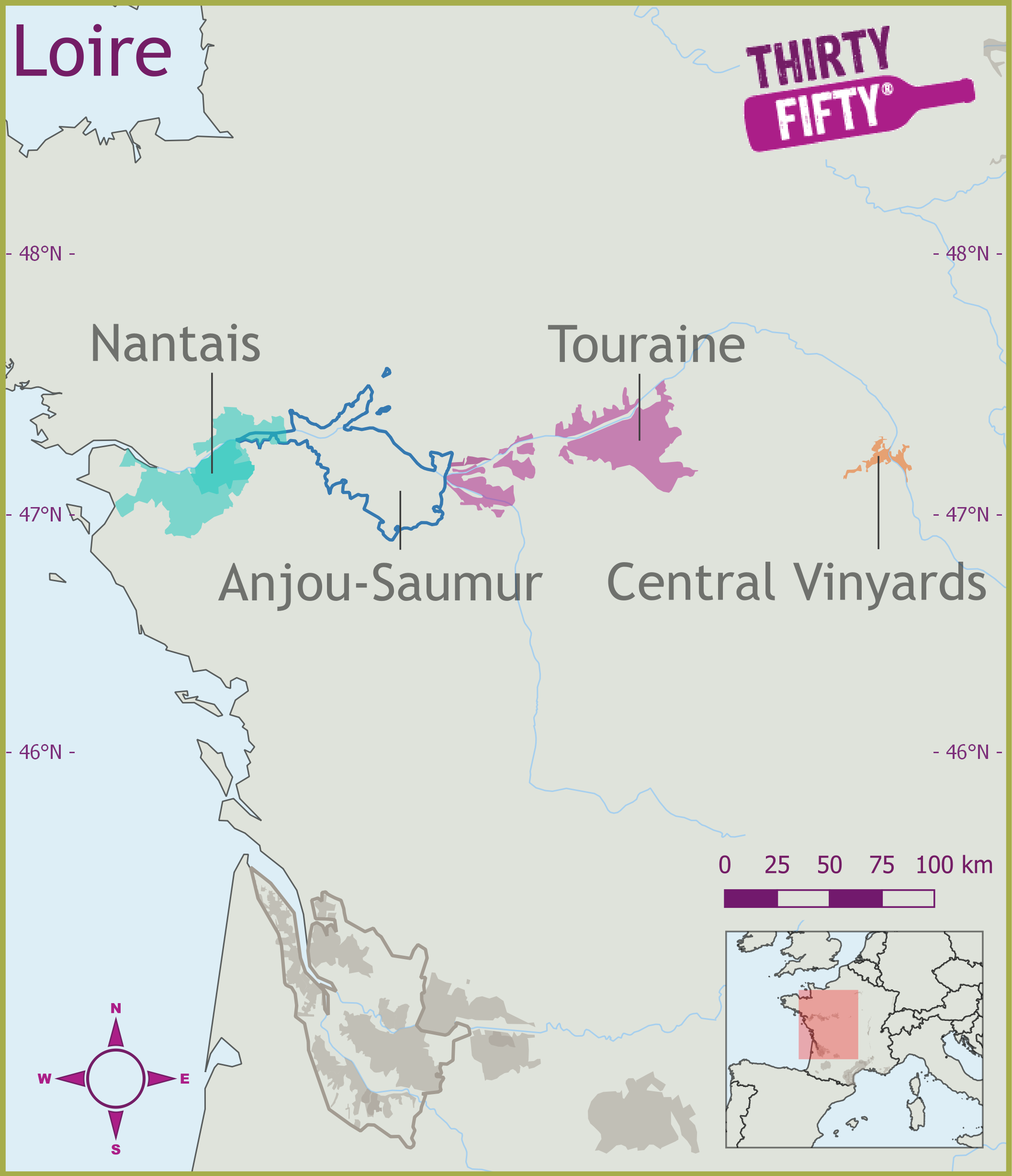
How do you sum up a wine region as diverse as the Loire? Difficult, really, considering all the various wines that it produces. But then it stretches from the Atlantic ocean, where the Gulf stream warms the Muscadet area, far east and inland to the continentally influenced Sancerre. And in between there are all manner of interesting wines being made, many of which are underrated outside France.
Generally, though, you have to remember that the Loire Valley (England aside) is at the northwestern limit of grape growing in Europe, so the character of the region’s wines depend very much on the weather and vintages can vary enormously. Getting grapes to ripen fully here can be a problem in cool summers, while hot years give the potential for fabulous sweet white wines. The high acidity this far north and intrinsic to some of the grape varieties grown mean the Loire is also suitable for sparkling wines (from cremant to liquoreux and a host of rosés) – and then there are the delicate reds and the fine whites.
Not surprisingly, then, are the grape varieties diverse too – from Melon de Bourgogne and Folle Blanche at the mouth of the Loire to Sauvignon Blanc and Pinot Noir in the upper Loire Valley. Chenin Blanc and Cabernet Franc have proved particularly successful in the middle area of Anjou-Saumur and Touraine, while other of the region’s vineyards are filled with Cabernet Sauvignon, Malbec, Gamay, Meunier, Pinot Gris and Chardonnay. However, the growth of so many internationally known varieties has meant grapes that are only grown in the Loire, such as Pineau d’Aunis, Grolleau and Arbois, have been losing favour.

This week we are talking to Kathleen Van den Berghe from Chateau de Miniere in Bourgueil, Loire Valley.

In this third interview with Benoit Roumet we taste 3 Sauvignon Blancs from the 2011 vintage.

In this final interview with Benoit Roumet we taste 3 Sauvignon Blancs from 3 older vintages.

In this second interview with Benoit Roumet we discuss the main grape varieties of the Loire Valley, France.

We meet Benoit Roumet to discuss the regions and grape varieties of the Loire Valley, France.
Closed wines tend to lack flavours for a period of their life, it generally implies the wine will open up after aging and have more aromas.
Closed wines tend to lack flavours for a period of their life, it generally implies the wine will open up after aging and have more aromas.
Closed wines tend to lack flavours for a period of their life, it generally implies the wine will open up after aging and have more aromas.
Closed wines tend to lack flavours for a period of their life, it generally implies the wine will open up after aging and have more aromas.
Closed wines tend to lack flavours for a period of their life, it generally implies the wine will open up after aging and have more aromas.
Closed wines tend to lack flavours for a period of their life, it generally implies the wine will open up after aging and have more aromas.
Closed wines tend to lack flavours for a period of their life, it generally implies the wine will open up after aging and have more aromas.
Closed wines tend to lack flavours for a period of their life, it generally implies the wine will open up after aging and have more aromas.
Cabernet Franc has been reported to possibly come from Navarra rather than France or the Basque Country Read more »
French reported weakest harvest in 30 years Read more »
Disputes overspill into vandalism in France Read more »