Beaujolais Nouveau top quality year
Beaujolais Nouveau 2025 shows its best form since 2022 Read more »


To book a wine tasting call us on
020 8288 0314 or to get in touch by
email please
click here.

Sign up to our Wine Club newsletter and keep up to date
with your wine knowledge, our latest on courses and
events.
BOOKINGS: 020 8288 0314


Gamay is the grape responsible for Beaujolais and, although it does pop up in a few other places, it is probably more than any other internationally known grape variety associated with this single wine region and single wine type. Officially called Gamay Noir a Jus Banc, it is a early budder, flowerer and ripener, making it prone to spring frosts, but it is able to flourish in regions as cool as much of the Loire, as well as other French regions � Maconnais and Savoie. Outside Beaujolais, this grape is chiefly valued in Switzerland. Gamay may well have originated further north than its main home � in the Cote d�Or, where it was planted extensively in the 14th century. However, now it has given way to Chardonnay bar a minor amount. Gamay wines, most of which are for drinking young, tend to be light purple with relatively high acidity, low tannin and the aroma of freshly picked red fruits often layered with bananas, boiled sweets and acetone, which are the smells that result from rapid, anaerated fermentation. Gamay excels on the rolling hillsides of the Haut-Beaujolais on granite-based soil. It is here that the finest wines are produced from the 10 Beaujolais crus, such as Fleurie and Morgon.
PDO's & PGI's
Key Grape Variety: Gamay
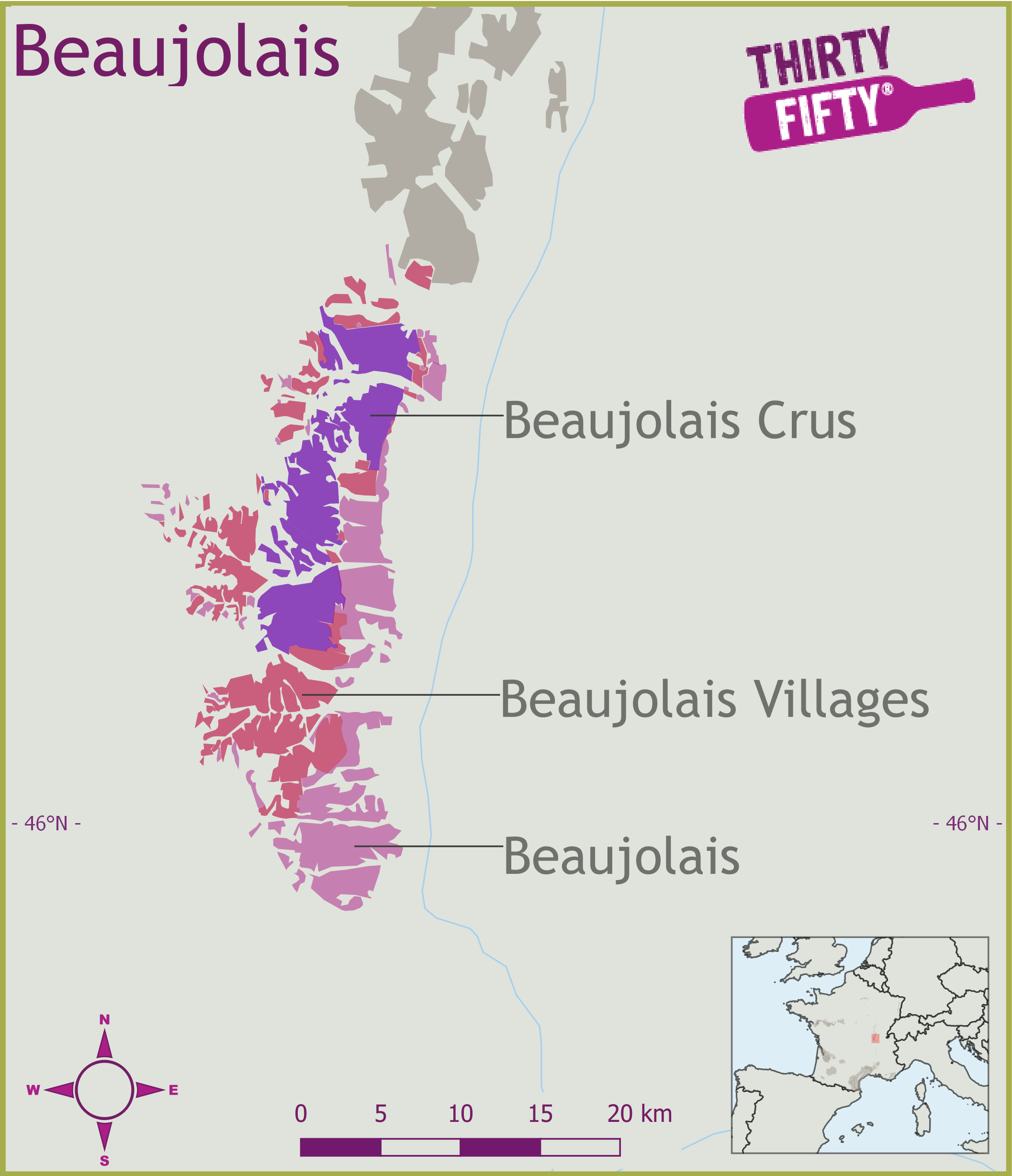
Beaujolais is a quantitively important wine region in east central France, due south of Macon, producing wine from the Gamay grape. For administrative purposes, this 34-mile stretch is often included in Burgundy but Beaujolais’ climate, topography, soils and grapes are quite distinct. The climate is temperate and semi-continental, while the landscape in the north of the region is made up of rolling granite and schist hills with some liimestone, while the south is flatter with richer soils, making the lighter wines for early drinking.
About half of the region’s wine is sold under the basic Beaujolais appellation, this coming from the southern Bas Beaujolais and the flatter land immediately west of the main north-south autoroute around Belleville.
Of course, the region also produces Nouveau, the youthful wine made for immediate consumption released each November. This can carry either the Beaujolais, Beaujolais Superior (minimum 10.5% alcohol) or Beaujolais-Villages appellation.
A small amount of white wine is made, mainly from Chardonnay and labelled Beaujolais Blanc and Beaujolais-Villages, and an even smaller amount of rosé.

In this show this week we talk to Christophe about the 12 appellations of Beaujolais with a focus on the 10 Cru Beaujolais, the highest category of classification in the region.

We talk with Christophe Coquard about Beaujolais Nouveau, the region, grape varieties and some of the unique methods in making Beaujolais Nouveau.
Beaujolais Nouveau 2025 shows its best form since 2022 Read more »
The INAO proposed that Chablis will no longer be allowed to make wines as part of the Bourogne AOC, but Beaujolais will. The proposal was dropped after outcry from producers. Read more »
Beaujolais’ exports to the UK appear to be bucking a trend with exports up 35% in volume and 19% by value in the first 8 months of 2019. Read more »