France hit by heavy frost, putting this year's vintage at risk
The coldest night in April since 1947 years has caused wide spread frost throughout France Read more »


To book a wine tasting call us on
020 8288 0314 or to get in touch by
email please
click here.

Sign up to our Wine Club newsletter and keep up to date
with your wine knowledge, our latest on courses and
events.
BOOKINGS: 020 8288 0314


Jancis Robinson described Chardonnay as the tart of the grape world, as it would lie down anywhere and do what the winemaker told it to do! In other words it will grow almost anywhere and produce decent and quite stylistically different wines ranging from minerally Chablis, Champagne, buttery fruit wines, tropical fruit wines or oaky vanilla wines. During the late 1990's Chardonnay was the drink of choice for many. However people became bored with the oaky wines found in so many bars and the term, 'ABC' (Anything but Chardonnay) came about. The ubiquitous yet noble Chardonnay grape has virtually become a brand name. From its homeland in Burgundy, its fame and fortune have taken it all over the world. It�s grown on different soils in varying climates to be used either as a single varietal or in blends, for still and sparkling wines, and with or without oak ageing to create a wide range of wines with diverse personalities. As a result, it�s impossible to describe a typical Chardonnay. For a start, the grape can make anything from an everyday glugger to a high-quality wine deserved of ageing. Its popularity in the vineyard stems from the fact that it�s easy to grow, consistently yielding generously with relatively high sugars (and, therefore, alcohol). In the winery its advantages are obvious � it�s difficult to make a poor wine from it, unless it�s been picked too late, because then its acid levels fall quickly, which make it flabby. Chardonnay isn�t strongly aromatic: some detect anything from apples (or barely ripe apples in Chablis) and melon in Maconnais Chardonnay to tropical fruit flavours in New World examples. Common descriptives, however, tend to refer to texture and weight rather than flavour � buttery for broader styles, such as Meursault from the Cote de Beaune; steely for Montrachets and nutty for Corton-Charlemagne. There�s an attractive leanness to fine Cote d�Or white burgundy, that sets it apart from Chardonnays from the rest of the world, but this can be emulated further south in the Cote Chalonnaise and Maconnais in good vintages with clever winemaking.
PDO's & PGI's
Pronounced as: Shab-lee
Key Grape Variety: Chardonnay
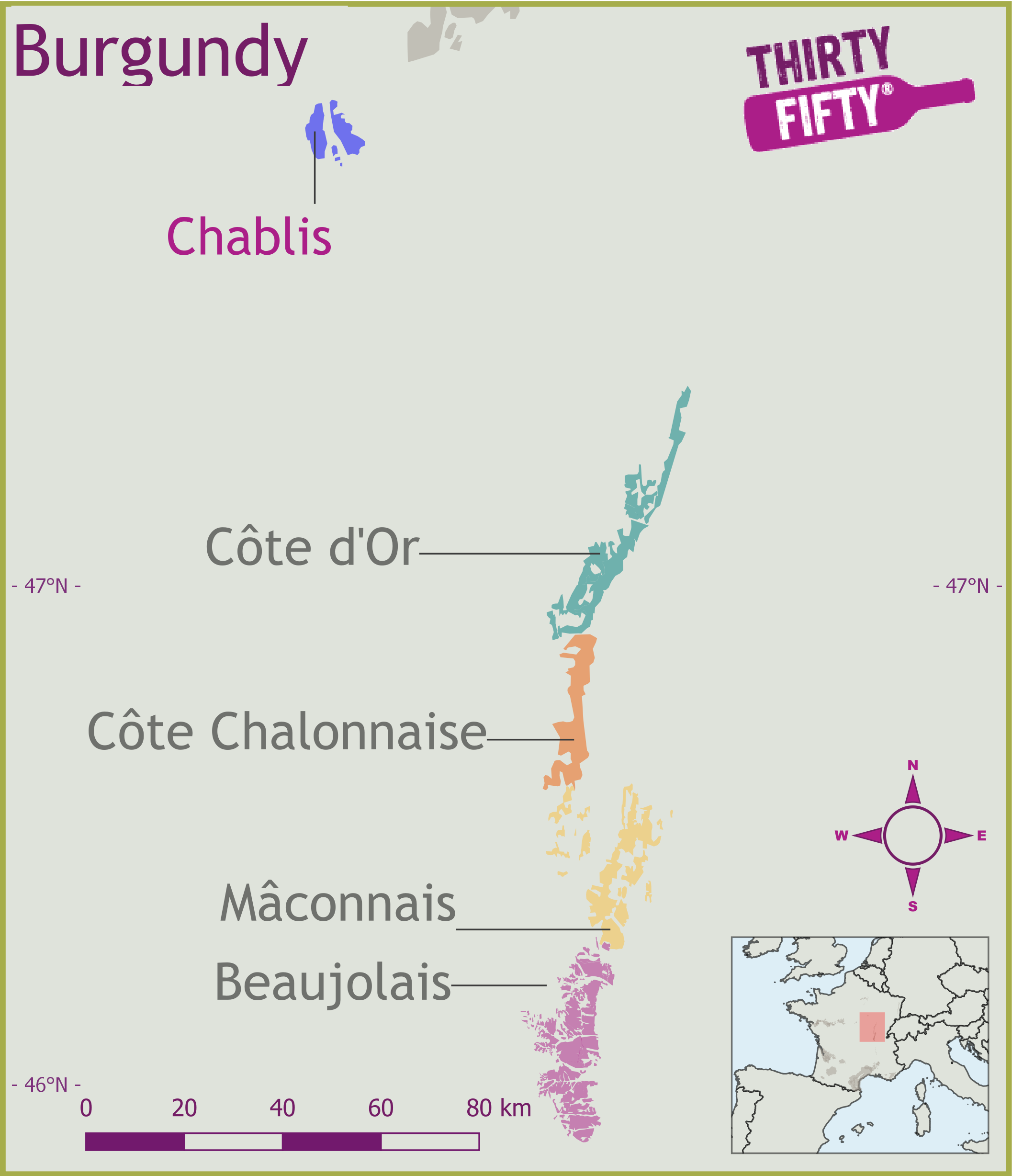
Chablis (pronounced Shab-lee) is a sub-region of Burgundy just to the northeast of central France, and centred around the town of Chablis. The large land mass around Chablis gives it a continental climate with cold winters and hot summers. The soils here have an important effect on the style of wine produced. On the best sites, limestone is overlaid with Kimmeridgian clay, which is a poor marl-type soil that's high in marine fossils. The best Chablis has a mineral streak to the wine, which is generally considered to come from the soil.
Recently, the demand for Chablis has resulted in the wine-producing region being extended and the new vineyards have limestone-only soils. Wine from this extended area, therefore, often lack the mineral streak and are not perceived to be as good, nor are they as expensive. You can tell whether the wine is from the new or the old region by the name on the label - if it says 'Petit Chablis', it's from the new region; if it says simply 'Chablis', it's from the old region. Whatever part of Chablis your wine comes from, it will always be made solely from the Chardonnay grape.
There is a total of 5,000 Ha under vine in Chablis, which is split over the different qulaity levels. Petit Chablis has 800Ha. While normal AC Chablis has the lion share with 3,500 Ha. Premier Cru Chablis has 750Ha and Grand Cru Chablis only has 100Ha under vine.

Nathalie and Gilles Fevre are the owners of Domaine Fevre in Chablis. We find out about the region and the wines of this famous French appellation.
The coldest night in April since 1947 years has caused wide spread frost throughout France Read more »
The INAO proposed that Chablis will no longer be allowed to make wines as part of the Bourogne AOC, but Beaujolais will. The proposal was dropped after outcry from producers. Read more »
French reported weakest harvest in 30 years Read more »