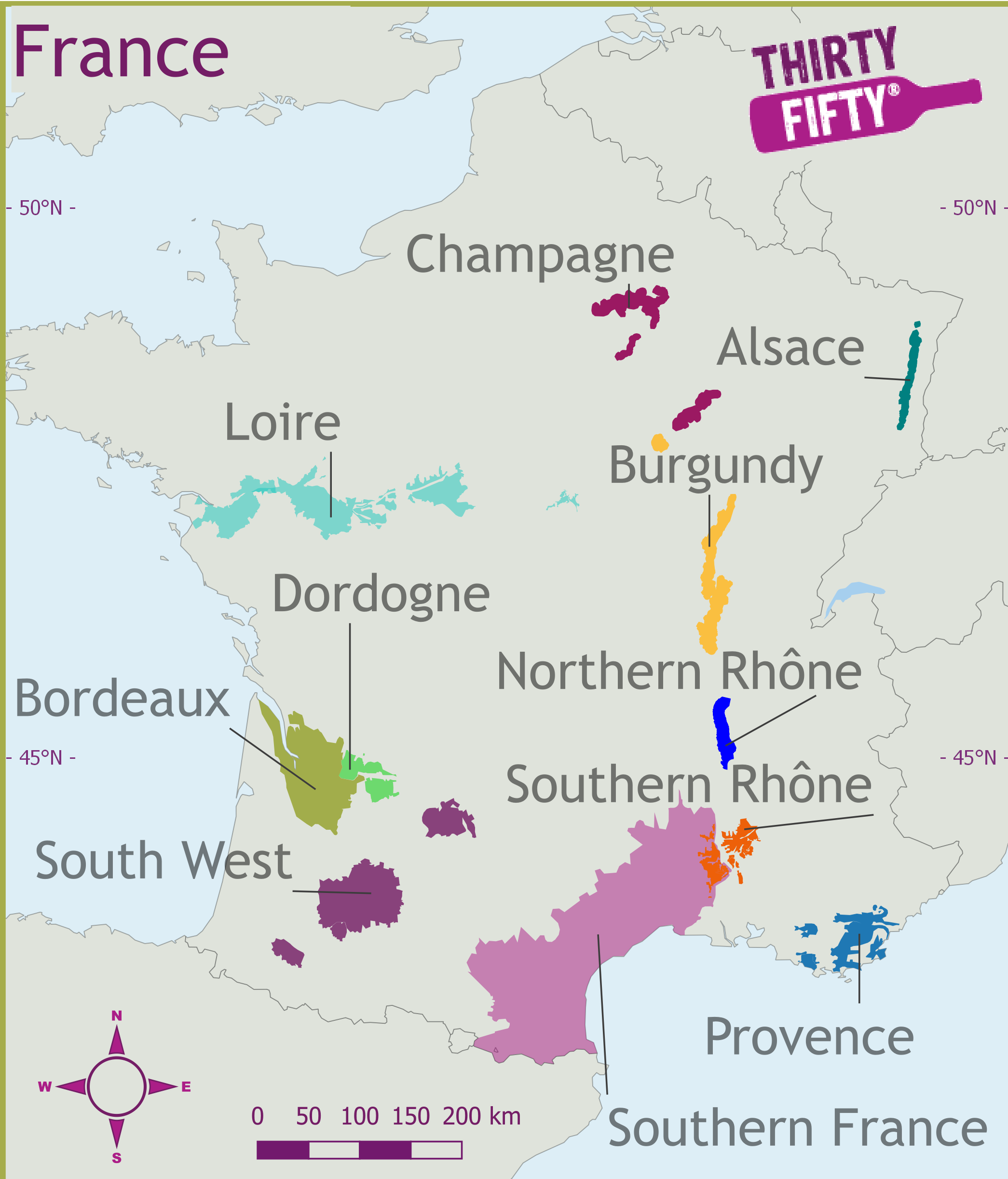


Languedoc and Roussillon's Grapes: Carignan, Chardonnay, Grenache, Mourvedre, Piquepoul, Syrah
Carignan
Carignan is a late-ripening black grape, which was the most widely planted variety in France from the mid-1960s until the end of the 20th century and also the most widely removed under the EU’s vine-pull scheme! Thought to have originated in Aragon in Spain, in France it was brought in to replace the very run-of-the-mill variety Aramon and is better than that. However, it has a long list of disadvantages. For a start, it’s not that easy to grow as it’s sensitive to both powdery and downy mildew and is prone to rot and grape worm infestation. It doesn’t lend itself to mechanical harvesting because its bunches hold on tight to the vine. Moreover, it lacks charm and finesse, being high in everything - acidity, tannin, colour and bitterness. As a result, it’s hard to approach young but it’s not enhanced by maturation. It’s attraction throughout France’s Midi during the 1950s and 1960s was based mainly on its ability to yield extremely well, as it can easily produce almost 200 hectolitres per hectare. However, it also buds late, which was one of its advantages over Aramon, which was particularly susceptible to frosts. It ripens late too, meaning it only thrives in relatively hot climates. All that said, on very poor soils with old vines Carignan with real character can be produced and blending it with varieties such as Grenache or Cinsaut helps to alleviate some of its astringency. The majority of France’s Carignan is found in the Languedoc departments of the Aude and Herault but it’s also in the Gard and around southeastern France. Spain still grows Carignan (or Carinena), though barely in Aragon now. Cataluna is where it’s most prevalent, though historically as a minor ingredient in Rioja with the synonym of Mazuelo. It’s also found in Priorat, which produces some of the world’s best Carignan-dominant wines, as well as Costers del Segre, Penedes, Tarragona and Terra Alta. Known as Carignane in the US, it’s chiefly used as part of a blend in California, while Israel has grown it as well as Italy, particularly Sardinia but also Lazio, where it’s called Carignano.
Chardonnay
Jancis Robinson described Chardonnay as the tart of the grape world, as it would lie down anywhere and do what the winemaker told it to do! In other words it will grow almost anywhere and produce decent and quite stylistically different wines ranging from minerally Chablis, Champagne, buttery fruit wines, tropical fruit wines or oaky vanilla wines. During the late 1990's Chardonnay was the drink of choice for many. However people became bored with the oaky wines found in so many bars and the term, 'ABC' (Anything but Chardonnay) came about. The ubiquitous yet noble Chardonnay grape has virtually become a brand name. From its homeland in Burgundy, its fame and fortune have taken it all over the world. It�s grown on different soils in varying climates to be used either as a single varietal or in blends, for still and sparkling wines, and with or without oak ageing to create a wide range of wines with diverse personalities. As a result, it�s impossible to describe a typical Chardonnay. For a start, the grape can make anything from an everyday glugger to a high-quality wine deserved of ageing. Its popularity in the vineyard stems from the fact that it�s easy to grow, consistently yielding generously with relatively high sugars (and, therefore, alcohol). In the winery its advantages are obvious � it�s difficult to make a poor wine from it, unless it�s been picked too late, because then its acid levels fall quickly, which make it flabby. Chardonnay isn�t strongly aromatic: some detect anything from apples (or barely ripe apples in Chablis) and melon in Maconnais Chardonnay to tropical fruit flavours in New World examples. Common descriptives, however, tend to refer to texture and weight rather than flavour � buttery for broader styles, such as Meursault from the Cote de Beaune; steely for Montrachets and nutty for Corton-Charlemagne. There�s an attractive leanness to fine Cote d�Or white burgundy, that sets it apart from Chardonnays from the rest of the world, but this can be emulated further south in the Cote Chalonnaise and Maconnais in good vintages with clever winemaking.
Grenache
Grenache or Garnacha, as it's called in Spain is a hot-climate red variety. It's origins are uncertain. As Garnacha, it probably originated in Spain, in Aragon in the north. But it is the same variety as Sardinia's Cannonau, so could have made its journey from there to Spain when Sardinia was under Aragon rule between 1297 and 1713. Whatever, it now has a large presence in France, particularly in the south in Languedoc-Roussillon and the southern Rhone. This high-yielding grape survives well in such hot, dry, windy vineyards as a result of its strong wood. It buds early and ripens relatively late and can achieve high sugar levels in regions that afford it a long growing cycle. Its weaknesses are lack of colour and low tannins, which is why it is often blended, such as in Rioja, but it is possible to concentrate both these characteristics if yields are kept low. Grenache wine has a tendency to oxidise early, a rustic quality and an attractive sweetness. However, in irrigated vineyards, such as much of the New World, the vine may lose even these taste markers. At the other extreme, if it is pruned severely, grown on the poorest soils and the vine and the grapes reach full maturity, then it can produce rich red wines needing several decades of cellaring - as some diligent producers in Chateauneuf-du-Pape have shown. Grenache certainly is a multi-purpose grape. Apart from producing dry reds, it is also the grape used for much of the rosé in France and Spain and is also the main ingredient for sweet vin doux naturels, such as Banyuls and Maury. In California, it produces the misleadingly named but popular rosé White Grenache, while Sardinia makes alcoholic reds and dessert wines from it. Beyond this, it's also found growing in Calabria, Sicily, Israel and both South and North Africa. Grenache is a grape with countless synonyms, including some that reflect its habitats, such as Tinto Aragones, Roussillon Tinto, Uva di Spagna, Alicante, Rivesaltes and Aragonais.
Mourvedre
Mourvedre is a vigorous red grape variety high in acidity and often astringency that is enjoying a revival in the south of France. It most likely originated in Spain, where – although declining – it is the fourth most planted red wine grape and known as Monastrell. With a warm climate, Mourvedre adapts well to a good range of soils and will ride out spring frosts. However, it doesn’t like low winter temperatures and is susceptible to downy and powdery mildew, which are more common in much of France than Spain. It buds and ripens very late – not a problem in Spain but in France it needs the warmest of summers to reach full ripeness. As Monastrell, the grape is grown particularly in Murcia, Alicante, Albacete, Valencia and the Levante where the resulting wines tend to be high in tannin and alcohol with a gamey flavour in youth – but it can age too. In southern France – throughout the Languedoc and Roussillon, as well as in Provence and the southern Rhone – Mourvedre is often used for its structure and makes wine with intense fruit and the aroma of blackberries in a good year. The Australians and Californians often called this grape Mataro but now, as a varietal or in a blend, it’s being offered as Mourvedre.
Piquepoul
Syrah
Shiraz and Syrah are the same grape. However apart from Australia where it is always called Shiraz, and France where it is Syrah, the rest of the world tends to follow the style of these two. If the wine is ripe and full bodied the wine is often called Shiraz. If the wine has less fruit, more acidity and lower alcohol, it tends to be called Syrah after the wines produced into the North of Rhone. Shiraz/Syrah is produced by itself or can be blended typically in three ways. A small amount of the white grape Viognier can lift the deep flavours of Syrah, this is common in Northern Rhone. In Southern Rhone and recently Australia, blending has been based around adding Grenache and Mourvedre, copying the blending behind Chateauneuf-du-Pape. Even more recently Cabernet Sauvignon and Shiraz/Syrah has been blended in the Southern French wine region of Languedoc, creating big wines with elegance. Hotter climate Shiraz often has aromas of plum, tar and leather and with the right oak treatment even chocolate. Cooler climate Syrah can have a peppery note to the wine.
PDO's & PGI's
- AC Languedoc
- AOC Corbières
- AOC Côtes du Roussillon
- AOC Côtes du Roussillon Villages
- AOC Fitou
- AOC Limoux
- AOC Minervois
- AOC Picpoul de Pinet
Languedoc and Roussillon
Key Grape Varieties: Carignan, Chardonnay, Grenache, Mourvedre, Piquepoul, Syrah